

Every December I get the same call. “Angie, is there anything I can still do before the year ends?”
Yes. More than most owners think.
If your business reports on the cash basis, you control two things in the last weeks of the year: when money goes out and when money comes in. The tax law gives you real room on both. It also lets you write off most of what you buy.
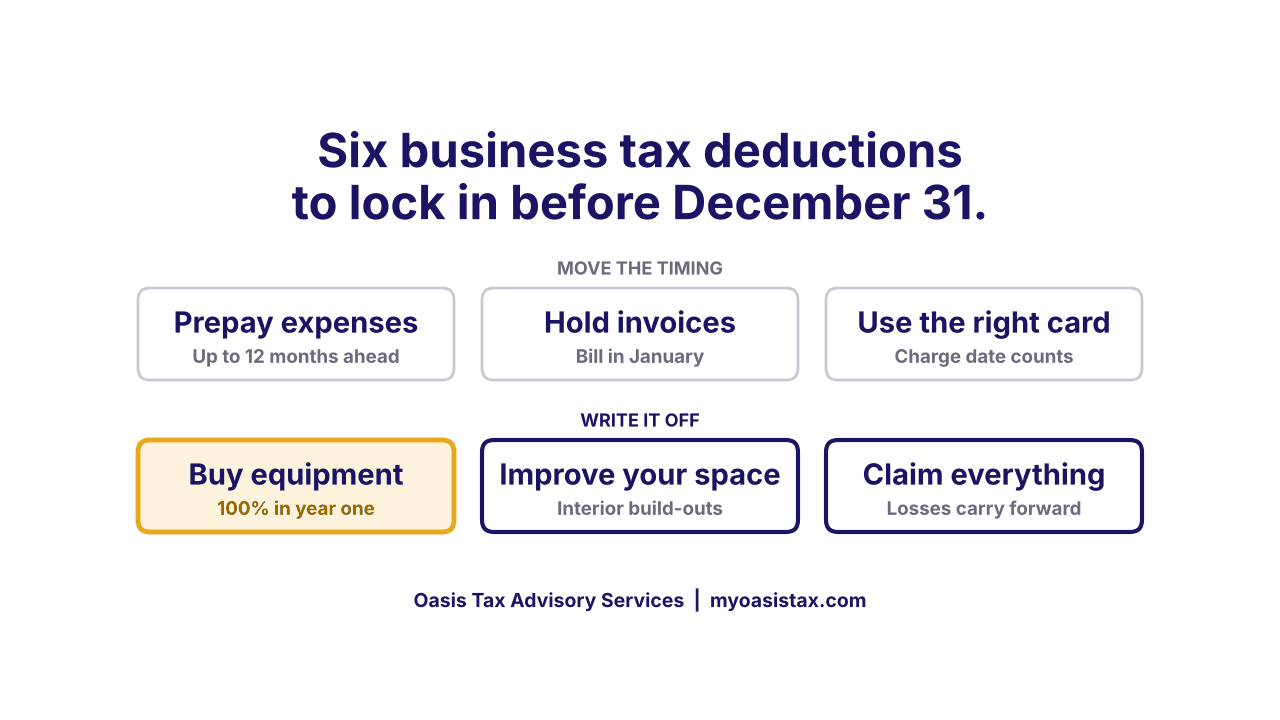
None of this is secret. Where it goes wrong is in the details: the check mailed a day late, the equipment still in the box on January 2, the reimbursement nobody processed. Here are six moves that still work for 2026, and what it takes to make each one hold up.
1. Prepay Next Year’s Expenses, Up to 12 Months
The IRS has a 12-month rule for cash-basis businesses. If you prepay an expense and the benefit does not run more than 12 months out, you deduct it in the year you pay it.
The usual candidates are office rent, lease payments on equipment and business vehicles, and business or malpractice insurance premiums.
Say your office lease is $4,500 a month. Pay all twelve months of 2027 in December, and you have a $54,000 deduction on your 2026 return.
What makes it hold up:
- Talk to your landlord first. A landlord who is surprised by a year of rent may send the check back, and a returned check is not a payment.
- Prove the date. Mail it certified or with tracking, and print the tracking page for your tax file. The post office does not keep that record as long as the IRS can ask for it.
- Stay inside 12 months. A December 2026 prepayment can cover 2027. It cannot reach into 2028.
One honest note. This moves next year’s deduction into this year. It does not create a new one. It works best when 2026 is your higher-income year, or when you plan to do it again next December.
2. Hold Your December Invoices Until January
On the cash basis, income counts when you receive it. Clients, patients, and insurance companies generally do not pay until they are billed.
So a consulting firm that normally invoices on the 15th and the 30th can send December’s invoices on January 2. The work is done in 2026. The income lands in 2027.
Two limits:
- You cannot hold money you already have. A check that arrives in December, or a payment sitting in your merchant account, is 2026 income whether you deposit it or not.
- Check your cash first. January payroll and rent still have to clear. Delay only what the business can afford to wait for.
3. Buy the Equipment You Actually Need
For 2026, most business equipment can be written off in full in the year you start using it. Bonus depreciation is back to 100 percent for property acquired after January 19, 2025, and Section 179 allows up to $2,560,000, with the limit shrinking once purchases pass $4,090,000.
That covers new and used machinery, computers, desks, furniture, and certain vehicles.
Three things to check before you sign:
- Placed in service means in use. Ordered is not enough. Paid is not enough. The equipment has to be set up and ready to work by December 31.
- A big write-off can shrink another deduction. If you qualify for the 20 percent qualified business income deduction, lower profit means a smaller one. Run the numbers both ways.
- Your state may not follow. Virginia, for one, does not allow federal bonus depreciation.
And do not buy just to save tax. A $40,000 purchase that saves $12,000 still costs you $28,000. For the full comparison, read Section 179 vs. 100% Bonus Depreciation.
4. Put Year-End Purchases on the Right Credit Card
A credit card charge is deductible on the day you make it, not the day you pay the statement. Which card you use decides whether that rule works for you.
- Sole proprietor or single-member LLC filing Schedule C. The charge date is the deduction date, on a business card or a personal one.
- Corporation with a card in the corporation’s name. Same rule. The charge date is the deduction date.
- Corporation, but the card is in your personal name. The corporation gets the deduction only when it reimburses you. Turn in the expense report and have the reimbursement paid by December 31.
That third one is where I see deductions slip into the wrong year. The purchase happened in December. The reimbursement happened in February.
5. Claim Every Deduction You Are Entitled To
I still meet owners, especially newer ones, who leave real expenses off the return because they are afraid a loss will look bad.
A legitimate deduction with records behind it holds up. Leaving it off does not make you safer. It just means you paid tax you did not owe.
If your deductions are larger than your income, you have a loss, and the tax law generally lets a net operating loss carry forward to future years. In a later year it can offset up to 80 percent of that year’s taxable income, and there are limits on how much loss an individual owner can use at once. The loss is not wasted. It waits.
So keep documenting. Every receipt, every mileage entry, every business purpose.
6. Finish Interior Improvements to Your Commercial Space
If you improved the inside of a commercial building this year, you may be sitting on a deduction you were planning to spread over 39 years.
Interior improvements to a nonresidential building, made after the building was first put into use, are called qualified improvement property. They are treated as 15-year property, which makes them eligible for Section 179 and 100 percent bonus depreciation.
Think new walls, flooring, lighting, and interior build-outs in an office, a store, or a clinic. Three things do not count: making the building bigger, elevators and escalators, and changes to the building’s internal structural framework.
The same deadline applies. The work has to be finished and in use by December 31, 2026. If you paid for a build-out in space you lease, ask whether it qualifies before you assume it does not.
Before December 31
- Run a 2026 projection first. Know your income before you decide how much to move or write off.
- Call your landlord and your insurance agent if you plan to prepay.
- Mail prepayments with proof and keep the tracking record.
- Decide which December invoices can wait without hurting cash flow.
- Confirm delivery and setup dates on equipment and improvements.
- Clear every expense report. Corporate reimbursements must be paid by December 31.
- Gather your records. Receipts, mileage, and the business purpose of each expense.
Frequently Asked Questions
Can I deduct prepaid rent in the year I pay it?
Yes, if your business uses the cash method and the prepayment covers no more than 12 months. A December 2026 payment for all of 2027 is deductible in 2026. Keep proof of the date you paid.
Is it legal to wait until January to bill my clients?
Yes, for a cash-basis business. Income counts when you receive it, so invoices sent in January are generally paid and taxed in the new year. Money you already received or could access in December still counts for this year.
What is the Section 179 limit for 2026?
$2,560,000, with the limit reduced dollar for dollar once you place more than $4,090,000 of qualifying property in service during the year. Bonus depreciation is also 100 percent for property acquired after January 19, 2025.
When is a business credit card purchase deductible?
On the day of the charge, if you file Schedule C or the card is in your corporation’s name. If your corporation’s purchase went on your personal card, the deduction waits until the corporation reimburses you.
Can my business deductions create a loss?
Yes. If legitimate deductions exceed income, you have a loss, and a net operating loss generally carries forward to offset income in later years, up to 80 percent of that year’s taxable income.
What is qualified improvement property?
An improvement to the interior of a nonresidential building, made after the building was first placed in service. It is 15-year property and can qualify for Section 179 or 100 percent bonus depreciation. Enlargements, elevators, escalators, and structural framework changes are excluded.
What to Do With This
Every one of these moves is public information. What decides whether it works is the order and the paperwork: the projection before the purchase, the proof of the mailing date, the reimbursement paid on time.
Some of these moves also push income or deductions into 2027, so the right amount is rarely “as much as possible.” It depends on what both years look like.
We will look at your 2026 numbers, tell you which of these six fit your business, and make sure each one is documented so it holds up.
Book a call with Angie at myoasistax.com/book-a-call. Bring your year-to-date profit and loss and last year’s return.
When a significant financial decision is ahead, Angie is the trusted advisor her clients call first. You deserve that same calm, practical guidance.
This article is general education, not individualized tax advice. These strategies assume a cash-basis, calendar-year business. Limits are adjusted annually, and state treatment varies. Your numbers decide what applies.
Related reading
- Section 179 vs. 100% Bonus Depreciation: What to Buy Before December 31 (2026)
- Year-End Tax Planning for Small Business Owners: 7 Smart Moves to Make Before December 31
- IRS Estimated Tax Payments: What Business Owners and High Earners Need to Know
Need help with this? Learn about our tax planning services or book a call with Angie Toney, CPA.
