

You spent a decade learning to practice medicine. Nobody spent a week teaching you how your income gets taxed.
So you do what most physicians do. You earn well, you pay a lot, and once a year someone files the return and tells you the number. The number is big. You assume that is the cost of earning what you earn.
It is not. It is the cost of nobody planning.
I review physician returns every week. The same five mistakes show up on most of them. None of them are exotic. All of them are fixable, and the fix almost never comes from the person who filed last year’s return.
Mistake 1: Treating the W-2 as the Whole Story
Most physicians have income that is not on the W-2. Locums shifts. Moonlighting. Medical directorships. Expert witness work. Speaking. A 1099 shows up in January and gets dropped on Schedule C like a receipt.
That 1099 income is the most flexible money you have. It can fund a solo 401(k) on top of your hospital plan. It can run through an entity that pays for the things the hospital does not. It can support a retirement plan that takes six figures off your taxable income.
Left on Schedule C with nothing attached to it, it is taxed at your top rate plus self-employment tax. That is the single most expensive way to earn a dollar.
Mistake 2: Setting Your Owner Pay Once and Never Looking at It Again
If you own the practice, you picked an entity at formation and someone picked your salary. That was years ago. Revenue changed. Partners changed. The tax law changed. The salary did not.
The split between what you take as wages and what you take as distributions drives your payroll tax, your retirement plan limits, your qualified business income deduction, and whether the IRS looks twice. It is a number that should be reviewed every year with the numbers in front of you. On most of the returns I see, it has never been reviewed once.
Mistake 3: Maxing the 401(k) and Stopping
The 401(k) limit is a ceiling for employees. It is a floor for practice owners.
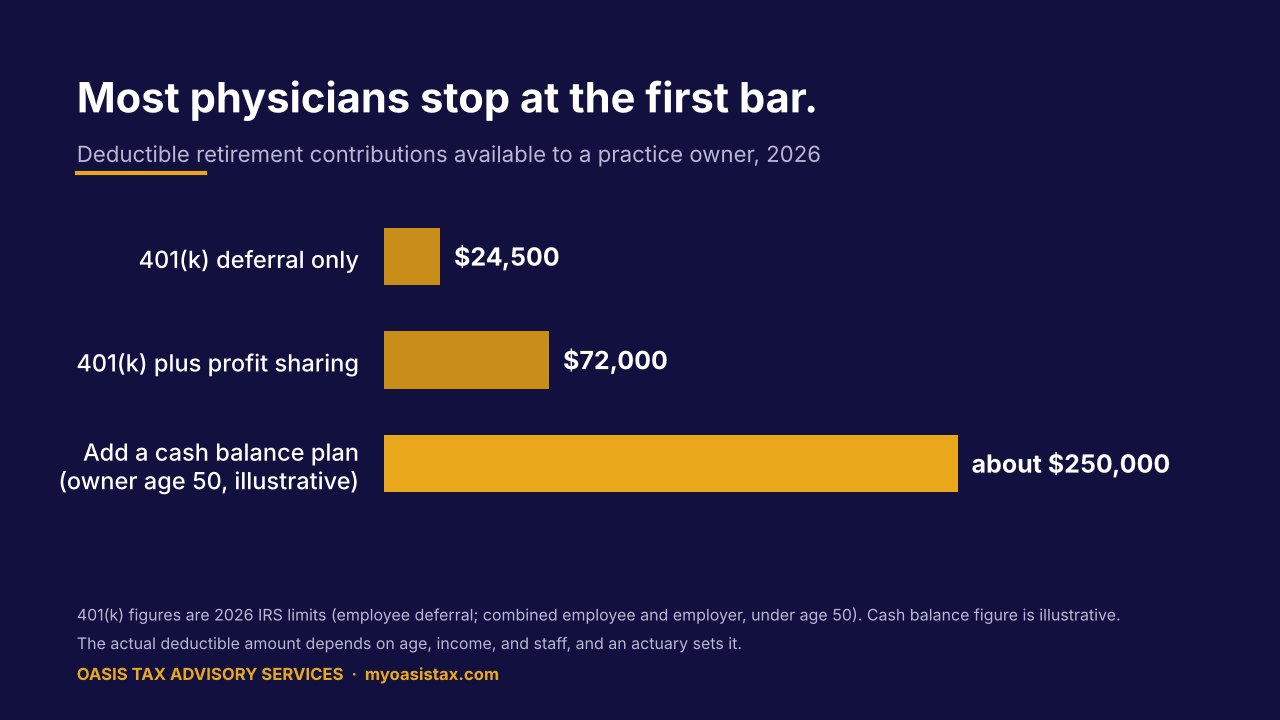
A defined benefit or cash balance plan, layered on top of a 401(k) and profit sharing, can allow a physician in their forties or fifties to deduct well over six figures a year. The exact figure depends on your age, your income, and your staff, and an actuary sets it. I have seen the deductible contribution exceed $200,000 for the right owner. Verify your own number before you count on it.
If you own the practice, earn well, and have fewer than a dozen employees, and nobody has run this calculation for you, that is the mistake. Here is how a cash balance plan works and what it costs to run.
Mistake 4: Leaving Your Family Out of the Plan
Your spouse and your children are not deductions. They are taxpayers with their own brackets, and most physician households never use them.
A child with a real job in the practice earns wages that are deductible to you and, up to the standard deduction ($16,100 for a single filer in 2026), taxed at zero to them. Those wages can fund a Roth IRA at an age where compounding does most of the work. A spouse on payroll with a real role can double the retirement plan contributions. A family management company can hold the administrative work and the income that comes with it.
Every one of these needs documentation and a real job behind it. Done right, it moves income from your bracket to theirs. Done casually, it is an audit finding. The difference is planning before the year starts, not a conversation in April.
Mistake 5: Buying Real Estate and Assuming the Losses Count
Physicians buy rental property for the depreciation. Then the loss sits on the return, suspended, offsetting nothing, because the passive activity rules do not care how much you paid for the building.
There are three ways real estate losses reach a physician’s income. Short-term rentals with material participation. A spouse who qualifies as a real estate professional. Or the building your own practice operates from, structured so the rent and the depreciation work for you instead of against you. Each one has rules, hours tests, and paperwork. None of them happen by accident after the closing.
If you bought the building and nobody talked to you about any of this, the loss is probably sitting there doing nothing.
The Mistake Behind the Mistakes
All five of these have the same cause. Your tax work happens after the year ends, when every number is already fixed. A return filed in April cannot change what you earned, how you were paid, what plan you funded, or who was on payroll. It can only report it.
Planning happens before. That is the whole difference between a preparer and an advisor, and it is why the physicians who pay the least are rarely the ones with the cleverest preparer. They are the ones who sat down in the fall.
Not a Physician?
I wrote this for doctors because I see so many of their returns. The mistakes are not medical. If you own a business that clears a healthy profit, or you invest in real estate with real money, read the list again and swap the word “practice” for your company. Mistakes 2 through 5 are yours too, and business owners usually have Mistake 1 in reverse: everything runs through the entity and nothing is structured around the owner.
Frequently Asked Questions
Do employed physicians with only W-2 income have any tax planning options?
Fewer than practice owners, but real ones. Any 1099 income (locums, directorships, expert witness, speaking) can fund a solo 401(k) and support an entity. Beyond that, retirement plan elections, charitable timing, equity and deferred compensation timing, and real estate structured correctly all apply to W-2 physicians.
How much can a physician contribute to retirement plans in 2026?
The 2026 401(k) employee deferral limit is $24,500, and the combined employee and employer limit for a defined contribution plan is $72,000 for someone under 50. A cash balance or defined benefit plan on top of that can add well over six figures for a practice owner in their forties or fifties. The exact amount is set by an actuary based on age, income, and staff.
Can I hire my children in my medical practice?
Yes, if they do real work, are paid a reasonable wage for it, and the hours and duties are documented. Wages up to the standard deduction ($16,100 for a single filer in 2026) are generally taxed at zero to the child and are deductible to the practice. The earned income can also fund a Roth IRA.
Why are my rental property losses not reducing my taxes?
Rental losses are passive by default, and passive losses only offset passive income. They reach a physician’s wages or practice income only through specific exceptions: a short-term rental with material participation, a spouse who qualifies as a real estate professional, or a properly structured self-rental of the building the practice uses. Otherwise the losses are suspended and carried forward.
When should a physician start tax planning for the year?
Before the year ends, ideally by early fall. Owner compensation, retirement plan funding, payroll for family members, and real estate elections all have to be in place during the year. A return prepared in April reports what already happened and cannot change it.
What to Do With This
If you paid more than $50,000 in personal income tax last year and nobody sat down with you before the year ended, at least two of these are on your return right now.
The first step at Oasis is a planning conversation, not a return. We look at what you earn, how it is structured, and what the plan would be worth to you before you pay for anything. If the math does not work, I will tell you.
Book a call with Angie at myoasistax.com/book-a-call. Bring last year’s return. We will tell you plainly which of these five are on it and what fixing them is worth.
When a significant financial decision is ahead, Angie is the trusted advisor her clients call first. You deserve that same calm, practical guidance.
This article is general education, not individualized tax advice. Retirement plan contribution amounts depend on actuarial assumptions and current IRS limits, which change annually. Your numbers decide what applies.
Related reading
- What Is a Cash Balance Plan, and Is It Worth It? A 2026 Guide for Business Owners
- Year-End Tax Planning for Small Business Owners: 7 Smart Moves to Make Before December 31
- IRS Estimated Tax Payments: What Business Owners and High Earners Need to Know
Need help with this? Learn about our tax planning services or book a call with Angie Toney, CPA.
