

This is the call I am getting more than any other right now.
“Angie, I sent everything in. You sent everything in. And I just got another letter saying I owe.”
Sometimes the client already paid. Sometimes we already mailed a response with every document the IRS asked for. Sometimes I already have a power of attorney on file and have spoken to someone at the IRS about the account. And the letters keep coming anyway, each one a little more serious than the last.
If that is you, take a deep breath. You are not imagining it, you did not necessarily do anything wrong, and in most cases this is fixable. Understanding how the IRS actually works right now explains almost all of it.
The IRS Is Running With a Lot Fewer People
The National Taxpayer Advocate, the independent watchdog inside the IRS, reported to Congress in June 2026 that the agency went from about 102,000 employees before the 2025 filing season to about 74,000 by the start of the 2026 filing season. That is a 27 percent drop in one year.
The work did not drop with it. At the end of the 2026 filing season, the IRS had about 10.5 million items waiting to be processed by hand. Roughly 3.3 million of those were pieces of taxpayer correspondence, meaning letters and responses people like you mailed in. In the main unit that handles account questions, about 63 percent of that correspondence was already past the IRS’s own processing timeframes.
The phones tell the same story. On the line for balance due and payment plans, only 31 percent of callers reached an IRS employee this filing season, and the people who got through waited an average of 45 minutes.
Why the Letters Keep Coming Anyway
Here is the part almost nobody explains.
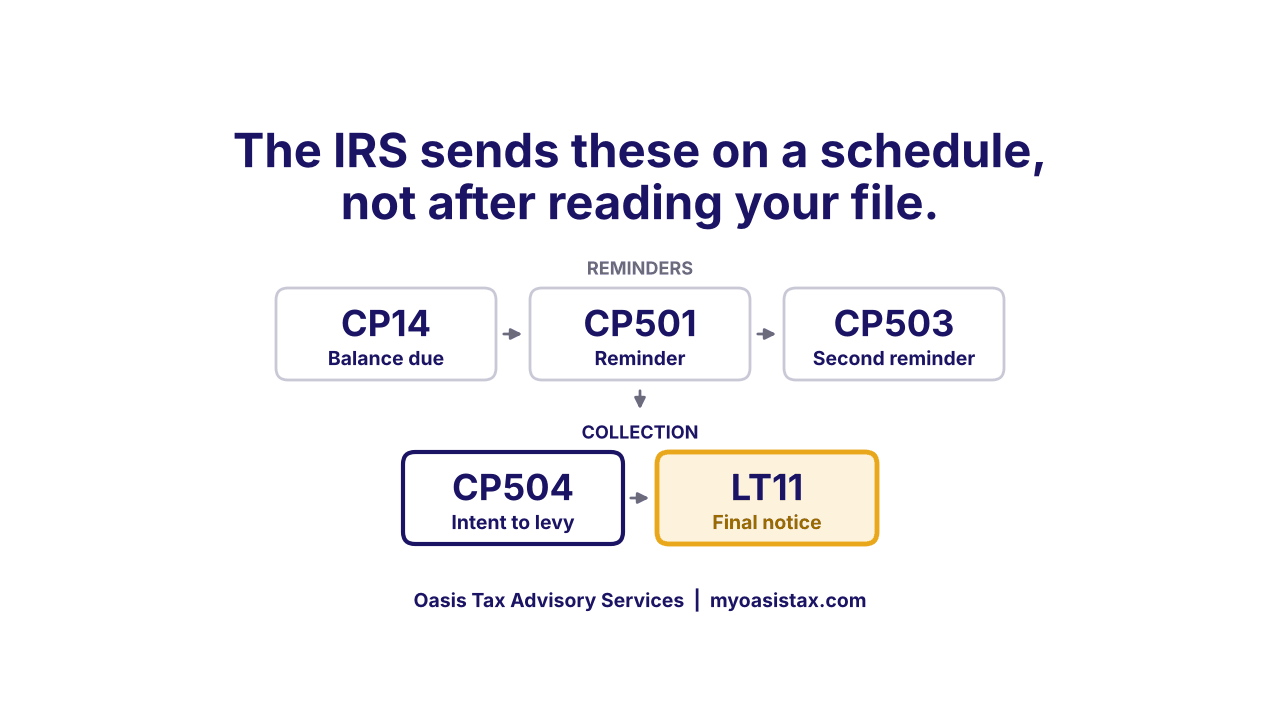
IRS collection notices are generated by computer. Once a balance shows on your account, the system sends the next notice in the sequence on a schedule. It does not know that your response is sitting in a mailroom in a stack of three million other letters. It does not know that your payment was received but has not posted yet. It only knows the balance is still there on the screen.
So you can do everything right, on time, and still get the next letter. The Taxpayer Advocate’s own report warns about exactly this: when the IRS is slow to process a taxpayer’s correspondence, its automated processes can take adverse action, such as moving forward with collection. The IRS itself put out a statement in June 2024 acknowledging that some CP14 balance due notices went to people who had already paid, because the notice was generated before the payment posted.
That is also why a phone call from your tax professional does not always stop the mail. A conversation with an IRS employee helps, and sometimes that person can place a temporary hold on collection. If the hold is not placed, or if it expires before the response is processed, the computer picks up right where it left off.
Online, the stories are the same week after week: a letter dated in April that arrived in May with only days left on the deadline, a second notice for a balance that was paid in full, a final notice that showed up while the response to the first one was still unopened. That is the system running on autopilot. Nobody at the IRS has looked at your file and decided anything about you yet.
The Letters You Are Most Likely to See
Every IRS notice has a code in the top or bottom right corner, usually starting with CP or LT. That code tells you exactly where you are in the process. Here are the ones I see most.
CP2000: “We think you underreported income.” The IRS matched your return against W-2s, 1099s, and other forms and found something that does not line up. This is a proposal, not a bill. You can agree, partially agree, or disagree with documents. Reply by the date on the notice. A large share of the CP2000s I see are wrong or partly wrong, usually because the IRS has the gross amount and not the cost basis, or because the income was reported in a different place on the return.
CP14: “You have a balance due.” The first bill. It asks for payment within 21 days. If you already paid, check your IRS online account or a transcript before you pay again. Paying twice creates a second problem.
CP501 and CP503: “Reminder” and “Second reminder.” The same balance, more interest, more urgency. These are the system moving forward on schedule.
CP504: “Notice of Intent to Levy.” This one matters. The IRS can now take your state tax refund, and it is warning you that wages, bank accounts, and other property come next. It can also come before a Notice of Federal Tax Lien is filed. Do not set this one aside.
LT11 or Letter 1058: “Final Notice of Intent to Levy and Notice of Your Right to a Hearing.” This is the most important letter in the whole sequence. It gives you 30 days from the date on the letter to request a Collection Due Process hearing on Form 12153. That hearing is your right to have an independent IRS Appeals officer review the collection before anything is taken. Miss the 30 days and that right is gone.
Letter 3172: “Notice of Federal Tax Lien Filing.” The IRS has filed a public lien. You also get hearing rights with this one, and the deadline is printed on the letter.
CP3219A: “Notice of Deficiency.” Sometimes called the 90-day letter. The IRS intends to assess additional tax, and you have 90 days to petition the U.S. Tax Court if you disagree. After that, the assessment goes through.
What I Tell Every Client Who Calls With a Letter
Open it the day it arrives. Look at the date printed on the letter, not the day you received it. The deadline runs from the printed date, and mail is slow.
Find the code and the deadline. Those two things tell you how urgent it is. A CP2000 and an LT11 are very different conversations.
Do not ignore it because someone already responded. If a response is in, the deadline on the new letter still matters. The next step may be to resend the response, to request a collection hold, or to file a hearing request to protect your rights while the original response is processed.
Send responses by certified mail, and keep everything. The receipt, a copy of what you sent, the date. If the IRS later says it never got it, that envelope is your proof.
Check the account yourself. An IRS online account or an account transcript shows what has actually posted. A letter shows what the system thought a few weeks ago.
Do not pay a balance you do not understand. That is the line I come back to more than any other. Before you pay, ask why they say you owe it. Penalties may qualify for relief. A substitute return may have ignored your expenses. A payment may have been applied to the wrong year. Do you actually owe what they say you owe?
What Representation Looks Like at Oasis
As a CPA, I can represent you before the IRS on any matter, in any state. When a client hires Oasis on an IRS matter, this is the order of operations.
- I get authorized. A signed Form 2848 lets me speak to the IRS for you and receive copies of your notices. From that point, most of the communication runs through me.
- I pull the record. Account transcripts for every year involved, so I can see every assessment, payment, penalty, and notice the IRS has on file. This is where I usually find out why the letters are still coming.
- I protect the deadlines. If there is a final notice, the hearing request goes in on time. If a hold is appropriate, I request it. If the response needs to be resent, it goes certified.
- I figure out what you actually owe. That may mean correcting a wrong assessment, getting a payment applied to the right year, filing a missing return, or requesting penalty relief.
- Then we resolve it. A payment plan, Currently Not Collectible status, an offer in compromise, or simply a correction that brings the balance to zero. Which one depends on what the record shows and what you can afford, and I will walk you through each option in plain language before anything is decided.
In this IRS, knowing the rules is the starting point. What makes the difference is the implementation: the timing, the documentation, and the follow-up until the account actually reflects what was sent. That is the part most people miss, and it is the part we do.
Frequently Asked Questions
Why did I get an IRS notice after I already responded?
IRS collection notices are sent by computer on a schedule. If your response or payment has not been processed yet, the system still sees the balance and sends the next letter. With about 3.3 million pieces of correspondence waiting at the end of the 2026 filing season, that gap can last weeks or months.
Do I still have to respond to a second IRS notice if I already answered the first one?
Yes. The deadline on the new letter still applies. Depending on the notice, the right step may be resending your response, asking for a collection hold, or filing a hearing request to protect your rights while the first response is processed.
What is the most important IRS letter not to miss?
The LT11 or Letter 1058, the Final Notice of Intent to Levy. It gives you 30 days from the date on the letter to request a Collection Due Process hearing on Form 12153. After that, the right to an independent Appeals review before levy is gone.
Is a CP2000 a bill?
No. A CP2000 is a proposed change based on information returns the IRS received. You can agree, partially agree, or disagree with documents by the response date on the notice.
How do I know if the IRS received my payment or response?
Check your IRS online account or request an account transcript. Those show what has actually posted. Keep certified mail receipts and copies of everything you send as proof.
Can a tax professional stop IRS notices?
A representative with a signed Form 2848 can speak to the IRS for you, receive copies of your notices, and request a temporary collection hold when appropriate. The notices stop for good once the account itself is corrected or resolved.
What to Do With This
If you have an IRS letter on the counter, especially one you thought was already handled, do not wait for the deadline on it to pass. Open it, find the code, and find the date.
Then let us look at it with you. We will tell you what the letter means, what the IRS record shows, and what resolution and representation would look like for your situation. IRS representation is federal, and we represent taxpayers in all 50 states by secure upload and phone.
Representation starts with an assessment, and the fee for it is $1,250. We pull your IRS transcripts, review the notices and any response already sent, check whether the balance is actually owed or can be reduced or abated, and lay out your resolution options before any other work begins.
Book a call with Angie at myoasistax.com/book-a-call. Bring the letter, and any response you already sent.
When a significant financial decision is ahead, Angie is the trusted advisor her clients call first. You deserve that same calm, practical guidance.
This article is general education, not individualized tax advice. IRS staffing and processing figures come from the National Taxpayer Advocate’s June 2026 report and change over time. Notice deadlines are printed on each letter and run from the date shown on it.
Related reading
- What Does the IRS Actually Have on You? A Guide to Transcripts and What They Reveal
- Why Hire a Tax Professional to Represent You Before the IRS
- 5 Steps to Resolve IRS Tax Debt Without Losing Sleep
Need help with this? Learn about our IRS representation services or book a call with Angie Toney, CPA. If the issue is a balance you can still plan around before year-end, start with tax planning instead.
