

If you inherited an IRA from a parent or another relative after 2019, there is a good chance you were told one thing: “You have ten years to empty it.” That was only half the story.
For many beneficiaries, the IRS also expects a required minimum distribution (RMD) every single year inside that ten-year window. The IRS waived the penalty for missing those annual withdrawals from 2021 through 2024. That grace period is over. Starting with the 2025 tax year, a missed inherited IRA RMD carries a real excise tax, and the 2026 withdrawal is due by December 31, 2026.
This guide explains who has to take annual RMDs from an inherited IRA, how to tell whether you missed one, what the penalty is, and how to fix a missed RMD before the year closes.
Who Must Take Annual RMDs From an Inherited IRA?
The answer depends on two things: who you are, and when the original owner died relative to their required beginning date (RBD). The RBD is April 1 of the year after the owner turned 73 under current law (72 for people who reached that age before 2023).
Most non-spouse beneficiaries who inherited in 2020 or later fall under the 10-year rule. Within that rule there are two paths:
- Owner died on or after their RBD. You must take an annual RMD in years one through nine, based on your own single life expectancy, and empty the account by December 31 of year ten.
- Owner died before their RBD. No annual RMD is required. You still must empty the account by December 31 of year ten.
Inherited Roth IRAs follow the second path. The owner of a Roth IRA is treated as dying before the RBD, so there are no annual RMDs, only the ten-year deadline.
A smaller group, called eligible designated beneficiaries, can still stretch distributions over their own life expectancy instead of ten years:
- A surviving spouse (who can also roll the account into their own IRA)
- The owner’s minor child, until age 21
- A disabled or chronically ill individual
- Anyone not more than 10 years younger than the owner
Eligible designated beneficiaries have annual RMDs too, so a missed year is a problem for them as well.
Why 2025 and 2026 Are Different
When the SECURE Act created the 10-year rule, most people read it as “take the money out any time within ten years.” The IRS later said that was wrong for beneficiaries of owners who had already started RMDs. The confusion was widespread enough that the IRS waived the missed-RMD penalty for 2021, 2022, 2023, and 2024 (Notices 2022-53, 2023-54, and 2024-35).
Final regulations were issued in July 2024 and apply to RMDs for 2025 and later. No further waiver has been announced. The IRS has indicated that beneficiaries do not have to make up the annual RMDs they skipped during the waiver years, but the ten-year clock never paused, and every year from 2025 forward counts.
In plain terms: if you inherited a traditional IRA from someone who had already reached their RBD, and you did not take a distribution in 2025, you most likely missed an RMD. If you have not taken one yet in 2026, you have until December 31 to avoid repeating the mistake.
How to Tell Whether You Missed an Inherited IRA RMD
Run through these questions with last year’s account statements in hand:
- When did the original owner die? If it was 2020 or later, the 10-year rule applies unless you are an eligible designated beneficiary.
- Had the owner reached their RBD? If the owner was 73 or older (72 under the older rules) and past April 1 of the year after reaching that age, the answer is yes. Annual RMDs apply to you.
- Is it a traditional or a Roth IRA? Roth beneficiaries have no annual RMD.
- Did you take any distribution in 2025? If not, and the first two answers point to annual RMDs, you missed the 2025 RMD.
- Have you taken the 2026 RMD? If not, the deadline is December 31, 2026.
The annual amount is the prior December 31 balance divided by your life-expectancy factor from the IRS Single Life Table, with the factor reduced by one each year after the first. Custodians do not always calculate this for inherited accounts, and when they do, they are not always right.
What a Missed Inherited IRA RMD Costs
The penalty is an excise tax under Internal Revenue Code Section 4974. SECURE 2.0 lowered it, but it is still steep:
- 25% of the amount you should have withdrawn and did not.
- 10% if you correct the shortfall within the correction window. The window generally runs through the end of the second tax year after the year of the missed RMD, or until the IRS sends a deficiency notice, whichever comes first.
- 0% if the IRS grants a reasonable-cause waiver, which it does regularly for honest mistakes when the missed amount has already been withdrawn.
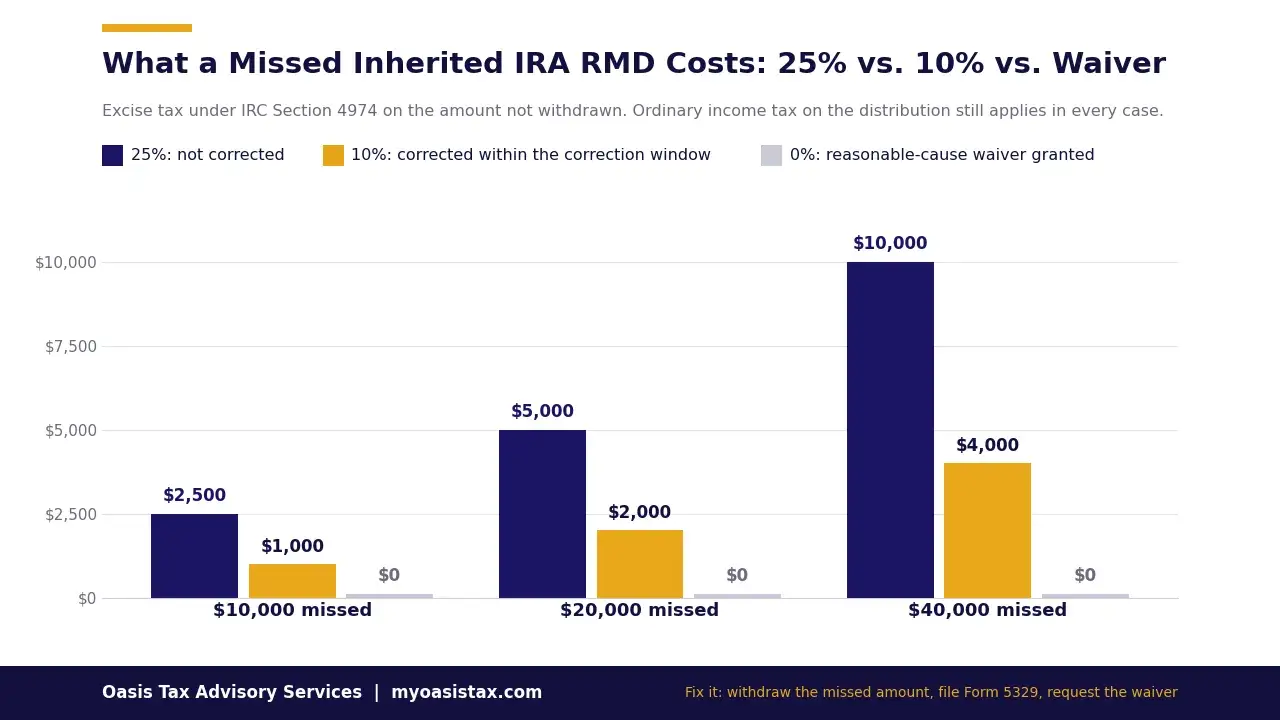
On a $20,000 missed RMD, that is $5,000 at the full rate, $2,000 if corrected in time, or nothing with a waiver. The ordinary income tax on the distribution itself is owed in every case; the excise tax is on top of it.
The correction window matters. A 2025 miss must be corrected by December 31, 2027 to qualify for the 10% rate. The sooner the fix is made, the stronger the waiver request looks.
How to Fix a Missed Inherited IRA RMD
- Calculate the shortfall. Use the December 31, 2024 balance and your Single Life Table factor to find the 2025 RMD. Do the same for 2026 using the December 31, 2025 balance.
- Withdraw the missed amount now. Take the full 2025 shortfall as a separate distribution from the inherited IRA. Do not roll it anywhere; inherited IRA distributions are not eligible for rollover.
- Take the 2026 RMD before December 31. Two separate distributions, two separate years, clean paper trail.
- File Form 5329 for 2025. Part IX reports the missed amount and the excise tax. If you already filed your 2025 return, file Form 5329 by itself for that year.
- Request the waiver. Enter “RC” and the amount you want waived next to the tax line, and attach a short letter explaining why the RMD was missed (custodian error, confusion over the rules, illness, a death in the family) and confirming the distribution has now been taken. Do not pay the excise tax with the request; the IRS will bill you if it denies the waiver.
- Keep the records. Statements showing the balances used, the distribution confirmations, and a copy of the Form 5329 and letter.
Filing Form 5329 also starts the statute of limitations on the excise tax. Without it, the IRS can assess the penalty years later.
The Year-of-Death RMD Is a Separate Trap
If the owner died after their RBD but before taking that year’s RMD, the beneficiary has to take it. The final regulations give you until the later of your tax filing deadline for the year of death or December 31 of the following year, and the penalty is waived automatically if you meet that deadline. For a 2025 death, that generally means December 31, 2026. Check this one before the year ends too.
Plan the Next Nine Years, Not Just This One
The annual RMD is the minimum, not a recommendation. Taking only the minimum for nine years and then emptying the account in year ten can push a large balance into the top brackets in a single year and trigger the 3.8% net investment income tax and higher Medicare premiums.
For most beneficiaries the better approach is to spread the withdrawals across the ten years so that each one fills a lower bracket. The right pattern depends on your other income, your state, and what else is happening in your financial life. That is a tax planning question, and the time to answer it is now, while the 2026 distribution can still be sized on purpose.
Frequently Asked Questions
Do I have to take an RMD from an inherited IRA every year?
If you are a non-spouse beneficiary under the 10-year rule and the original owner died on or after their required beginning date, yes. Annual RMDs are required in years one through nine and the account must be empty by the end of year ten. If the owner died before their RBD, or the account is a Roth IRA, only the ten-year deadline applies.
What is the penalty for a missed inherited IRA RMD?
A 25% excise tax on the amount not withdrawn, reduced to 10% if you correct it within the correction window. The IRS can waive the penalty entirely for reasonable cause when you have taken the missed amount and file Form 5329 with an explanation.
Do I need to make up the inherited IRA RMDs I skipped in 2021 through 2024?
The IRS waived the penalty for those years and has indicated that beneficiaries do not need to make up those distributions. The ten-year deadline did not change, so the account still has to be empty by the end of year ten.
When is the 2026 inherited IRA RMD due?
December 31, 2026. There is no April 1 extension for inherited accounts.
How do I report a missed RMD to the IRS?
File Form 5329 for the year the RMD was missed, complete Part IX, and either pay the excise tax or request a reasonable-cause waiver by writing “RC” next to the line and attaching a letter of explanation.
Can I take two years of RMDs in one year to catch up?
Yes. The missed amount and the current year’s amount can both be taken in the same calendar year. Both are taxable as ordinary income in the year received, so the combined amount may affect your bracket.
Does the 10-year rule apply to a Roth IRA I inherited?
Yes, the account must be emptied within ten years. There are no annual RMDs in between, and qualified Roth distributions are tax free, so many beneficiaries wait and let the account grow.
What if my custodian never told me about annual RMDs?
You are still responsible for the distribution, but custodian error is a common and accepted reason in a reasonable-cause waiver request. Take the missed amount, file Form 5329, and explain what happened.
Fix It Before December 31
A missed inherited IRA RMD is one of the easier tax problems to fix, and one of the most expensive to ignore. Take the missed distribution, take this year’s distribution, file Form 5329, and ask for the waiver. Then decide how the rest of the ten years should look.
At Oasis Tax Advisory Services, Angie reviews inherited accounts as part of a complete tax plan, calculates the correct RMDs, prepares the Form 5329 and waiver request, and maps out a withdrawal schedule that keeps the inheritance from landing in the wrong bracket.
Book a call with Angie at myoasistax.com/book-a-call. Bring the inherited IRA statements and the date the original owner passed. We will tell you plainly whether you missed an RMD, what it costs, and how to fix it before the year closes.
When a significant financial decision is ahead, Angie is the trusted advisor her clients call first. You deserve that same calm, practical guidance.
This article is general education, not individualized tax advice. Inherited IRA rules depend on the date of death, the beneficiary’s status, and the account type. Confirm your situation with a qualified advisor.
Related reading
- Year-End Tax Planning for Small Business Owners: 7 Smart Moves to Make Before December 31
- What Is a Cash Balance Plan, and Is It Worth It? A 2026 Guide for Business Owners
- IRS Estimated Tax Payments: What Business Owners and High Earners Need to Know
Need help with this? Learn about our tax planning services or book a call with Angie Toney, CPA.
